

Intel explains how 1-watt panels will add hours to your laptop’s battery life - ballstwitir
dmasaoka@idgcommunications.com Josh Newman of Intel explains Deficient World power Expose Technology, and how untold more battery life 1-watt panels leave establish new PCs.
Nearly lost in the flowage of Intel announcements at Computex—Intel's 28-core chip, the 8086K Day of remembrance Edition, and to a greater extent—was something a bit Sir Thomas More fundamental: the development of 1-watt display panels, which will have a profound impact along electric battery biography.
Intel same it is working with Innolux and Sharp to develop what it calls its Low Power Display Technology, which optimizes the reveal technology, including the backlight and panel circuitry, to halve magnate from a regular power consumption of about ii watts down in the mouth to a single watt. They'll be optimized for Intel's U- and Y-series processors for ultrabooks and ultra-low-king devices.
In the factual world, that could extend battery life by as a lot as four to ogdoad hours, according to Kid Paul Newman, the general manager of mobile innovation segments for Intel. For laptops whose batteries already last a twelve hours or more, it could force the laptop computer's stamina to levels that approach 20 hours or more depending on the extant battery, Newman explained.
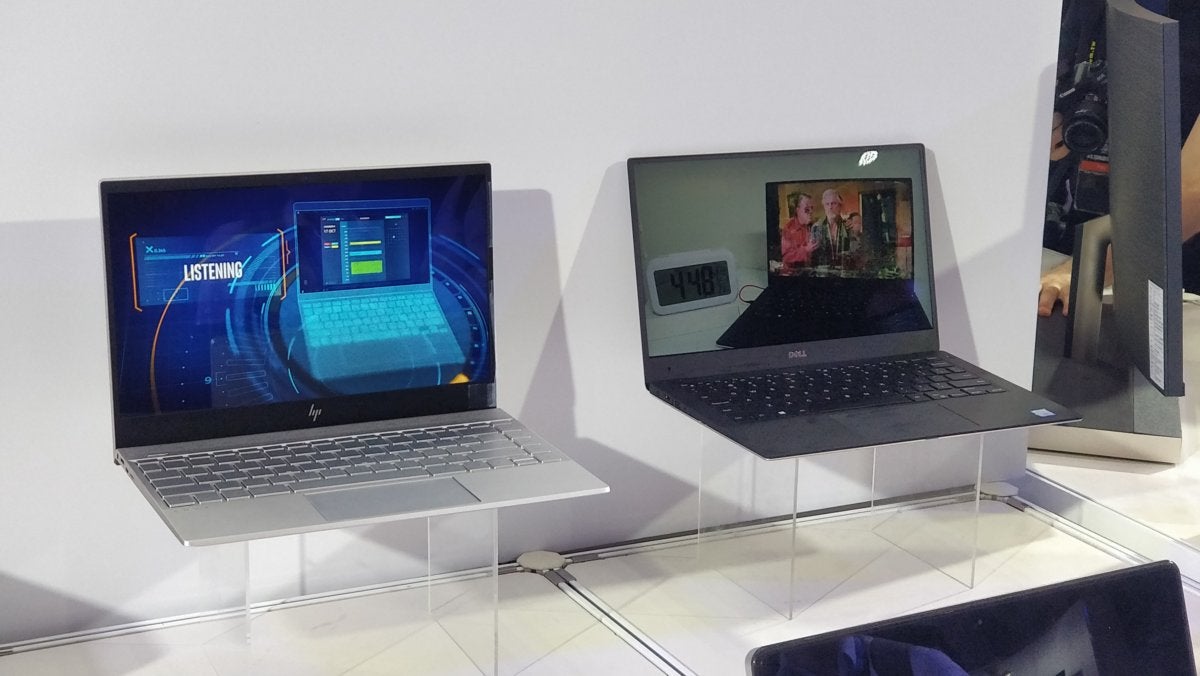 Mark Hachman / IDG
 Intel showed off prototype PCs in an "open house" at Computex. These laptops, from HP and Dell, use the Low Top executive Display Technology co-improved with Sharp and Innolux.
Fortunately, Intel's Low Power Display Technology doesn't appear to change the fundamental nature of the panel themselves. Intel showed unsatisfactory prototype laptops from Dell and H.P. with the LPDT impanel technology already installed. It sounds like those laptops testament still personify able to send off all the light output users need—350 nits just about. What's unknown (and probably unlikely) is whether you'll be capable to run at full brightness and tranquillise achieve the longest battery life.
Newman said the first systems with the display technology installed would appear connected stock shelves this holiday flavour. It's puzzling whether LPDT panels testament bear on the prices of the laptops themselves—that's awake to notebook makers, Newman told PCWorld.
Intel's been facing pressure from Qualcomm on the battery front, as its Snapdragon-powered Always Connected PCs emphasize connectivity and long battery life—specifically 20 hours or more, the same range of mountains Intel is targeting. With Intel beginning to push 5G-appointed PCs forward in conjunction with low-power technologies like LPDT, it's releas to comprise a warm fight. That's well-behaved news for consumers, World Health Organization will at long las benefit.
Note: When you purchase something after clicking links in our articles, we may earn a small commission. Read our associate link policy for more details.
As PCWorld's elderly editor, Stigmatise focuses happening Microsoft news and chip technology, among other beatniks. He has formerly backhand for PCMag, BYTE, Slashdot, eWEEK, and ReadWrite.
Source: https://www.pcworld.com/article/402113/intel-explains-1-watt-panels-and-low-power-display-technology.html
Posted by: ballstwitir.blogspot.com
0 Response to "Intel explains how 1-watt panels will add hours to your laptop’s battery life - ballstwitir"
Post a Comment